

Golf putters used by pros are precision-balanced putters designed for consistent face alignment, stable stroke paths, and improved distance control, which directly increases putting accuracy.
Most missed putts happen because of poor alignment, inconsistent stroke tempo, or incorrect head shape selection. Professional golfers solve this by choosing putters matched precisely to their stroke style, green speed preference, and visual alignment needs. The right professional-style putter does not magically fix technique—but it removes equipment-related errors that cost strokes every round.
If your putts frequently finish short, drift offline, or feel inconsistent from inside 10 feet, your current putter likely does not match your stroke mechanics. Understanding what pros use—and why—helps you choose equipment that supports repeatable performance instead of fighting against it.
Why do professional golfers carefully choose specific putter models?
Professionals select putters based on stroke arc, alignment preference, feel, and face balance because putting accounts for roughly 40% of total strokes in a round.
According to PGA Tour performance tracking data, elite players average between 28 and 30 putts per round. Even marginal improvements in putting efficiency translate directly into lower scores.
Pros evaluate putters using:
- Toe hang compatibility with stroke arc
- Alignment visibility at address
- Face insert responsiveness
- Head stability through impact
- Weight distribution
- Shaft offset preferences
Unlike recreational players, professionals rarely switch putters without measurable performance reasons. Many stay with the same model for years once confidence builds.
Which golf putter types are most commonly used by professionals?
The most common professional putter types are blade putters, mallet putters, and mid-mallet putters, each designed for different stroke styles and alignment needs.
What is a blade putter and who should use it?
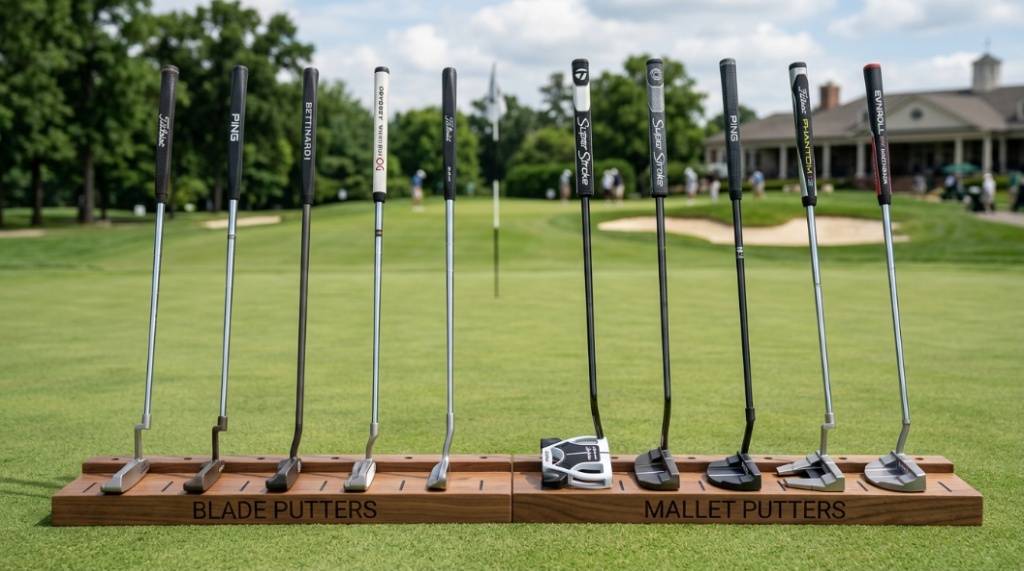
Blade putters are compact, toe-weighted putters preferred by players with a natural arc stroke.
Blade putters remain popular on professional tours because they provide superior feedback and precision control. Many traditional players rely on them for their clean alignment visuals.
Best suited for:
- Players with moderate-to-strong stroke arc
- Golfers prioritizing feel
- Low-handicap players
- Fast green conditions
Popular blade models frequently seen in professional bags include tour-milled carbon steel designs with subtle toe hang.
What is a mallet putter and why do pros use it?
Mallet putters offer higher forgiveness and improved alignment stability through perimeter weighting.
Modern professionals increasingly adopt mallet putters because they reduce face rotation during impact and improve consistency under pressure.
Benefits include:
- Larger sweet spot
- Enhanced stability
- Better distance control
- Visual alignment guides
What is a mid-mallet putter?
Mid-mallet putters combine blade-style feel with mallet-style forgiveness.
They appeal to golfers transitioning from blades but wanting more stability without losing traditional feedback.
Which specific golf putters used by pros are most trusted on tour?
Tour professionals frequently use models like Scotty Cameron Newport, Odyssey White Hot Versa, TaylorMade Spider Tour, and Ping PLD Anser due to their proven alignment accuracy and stability.
| Putter Model | Type | Best For | Key Advantage |
|---|---|---|---|
| Scotty Cameron Newport | Blade | Arc stroke players | Precision milled feel |
| Odyssey White Hot Versa | Mallet | Alignment-focused players | High-contrast aiming system |
| TaylorMade Spider Tour | Mallet | Stability seekers | Extreme perimeter weighting |
| Ping PLD Anser | Blade | Traditional stroke control | Tour-inspired shaping |
These models dominate professional leaderboards because they deliver consistent roll characteristics across varied green speeds.
How does stroke type determine which putter professionals choose?
Professionals match putter toe hang and balance to their stroke arc to maintain square face impact through contact.
Stroke style categories include:
What putter works best for straight-back-straight-through strokes?
Face-balanced mallet putters perform best for straight putting strokes.
These minimize face rotation and improve directional control.
What putter suits arc-style putting strokes?
Toe-hang blade putters match natural arc strokes more effectively.
This allows the clubface to rotate naturally during the putting motion.
Choosing the wrong toe hang often causes missed putts even with correct alignment.
Why do alignment features matter in golf putters used by pros?
Alignment aids help professionals square the clubface faster and maintain visual confidence over critical short putts.
Studies from equipment fitting labs show golfers align mallet putters up to 23% more accurately than traditional blades when visual guides are present.
Common alignment technologies include:
- Contrast striping
- Triple-line aiming systems
- Rear cavity sightlines
- Perpendicular framing geometry
Alignment clarity reduces mental interference during stroke execution.
How does putter weight affect accuracy on fast and slow greens?
Heavier putters improve consistency on slow greens, while lighter putters enhance touch on fast greens.
Professionals adjust head weight depending on tournament conditions.
Typical ranges include:
- 330–345 grams for fast greens
- 350–370 grams for medium greens
- 370+ grams for slower greens
Adjustable-weight putters allow fine tuning without replacing equipment.
Do face inserts improve putting accuracy compared to milled faces?
Face inserts soften impact feel and improve distance control, while milled faces provide sharper feedback and precision.
Professionals select face materials based on sensory preference rather than performance myths.
When should golfers choose insert putters?
Insert putters help players struggling with speed control on longer putts.
When should golfers choose milled putters?
Milled putters suit golfers prioritizing feedback and consistency inside 10 feet.
Tour adoption remains balanced between both designs.
How important is putter length when choosing equipment used by pros?
Putter length directly affects posture, eye alignment, and stroke path consistency.
Standard professional lengths include:
- 33 inches for compact posture players
- 34 inches for average stance alignment
- 35 inches for upright posture golfers
Incorrect length causes misalignment before stroke even begins.
What grip styles do professionals prefer for better accuracy?
Professionals select thicker grips to reduce wrist movement and maintain stable face control through impact.
Common grip choices include:
- Pistol grips for feedback control
- Oversized grips for stability
- Flat-front grips for alignment reference
Grip selection often improves short-putt confidence immediately.
Are expensive putters used by pros worth it for amateur golfers?
Premium putters used by professionals are worth the investment when properly fitted to stroke mechanics and alignment preferences.
Price reflects:
- Precision milling tolerances
- Material quality
- Weight distribution engineering
- Consistency testing
However, performance gains depend on fit—not brand prestige.
Should beginners use the same putters professionals use?
Beginners benefit most from forgiving mallet putters commonly used by professionals because they simplify alignment and stabilize impact.
High-MOI mallet designs reduce directional errors while building stroke confidence.
How can you test golf putters like professionals before choosing one?
Testing putters on real green surfaces while tracking alignment consistency and distance control provides the most reliable selection results.
Professionals evaluate putters using structured testing routines.
Recommended testing steps include:
- Check eye position at address
- Roll five-foot putts repeatedly
- Evaluate ten-foot distance control
- Test lag putt consistency
- Compare alignment confidence
Confidence during testing predicts on-course performance.
Conclusion: How do golf putters used by pros improve your accuracy?
Golf putters used by pros improve accuracy by matching stroke mechanics, enhancing alignment clarity, and stabilizing face impact through engineered weighting.
The best putter for accuracy is not necessarily the most expensive or popular model. It is the one aligned with your stroke arc, posture, and visual preferences. Professionals succeed because their equipment supports repeatable movement—not because they use exclusive gear.
If you want measurable improvement in putting performance, start by identifying your stroke style, testing face balance compatibility, and prioritizing alignment visibility. A properly selected professional-style putter can reduce three-putts, increase confidence inside ten feet, and lower scoring averages across every round.
Choose deliberately, test carefully, and treat your putter like the most important scoring club in your bag.
FAQ: Golf putters used by pros
What putter brand is most used by professional golfers?
Scotty Cameron putters are among the most widely used on professional tours because of their precision milling, balance control, and consistent feedback.
Do pros prefer blade or mallet putters?
Modern professionals increasingly prefer mallet putters for stability, though blade putters remain popular among players with strong arc strokes.
How often do professionals change their putters?
Most professionals keep the same putter for years unless performance metrics show measurable decline.
Are face-balanced putters better for accuracy?
Face-balanced putters improve accuracy for straight stroke players by reducing unwanted face rotation during impact.
What length putter do most pros use?
The majority of professionals use putters between 33 and 35 inches depending on posture and eye alignment.
Does putter weight affect distance control?
Yes, heavier putters improve consistency on slow greens while lighter putters enhance touch on faster greens.
Can using a pro-style putter lower scores immediately?
A properly fitted professional-style putter can reduce missed short putts quickly, but long-term scoring improvement depends on practice consistency.
Read More Also: How to Stay Hydrated During Long Workouts in Arizona (AZ)
Discover More: How to Balance Swimming and Running Training